
Marion County Ownership Trail
Tracing Marion County former owners works best as a backward timeline. Start with the deed tied to the present parcel. The seller on that deed is the grantor. Now find the older deed where that same person appeared as grantee. Each link must repeat the same land. Match the legal description, parcel number, PPIN, subdivision, or book and page at every step. A street address alone is weak evidence. Rural descriptions, road names, and parcel identifiers can all change over time.
| Transfer stage | Known coverage | Record home | Ownership clue |
|---|---|---|---|
| Online land index | 1997 to present | Chancery Clerk portal | Grantor, grantee, date, type, parcel, description and book/page |
| Courthouse land books | Before the web cutoff | Chancery Clerk | Earlier deeds and the references carried forward by later instruments |
| Subdivision plats | Book/page varies | Land index and GIS Subdivision layer | Lot, block and subdivision relationships behind an old description |
| Tax and probate material | Selected historical years | Courthouse, MDAH and FamilySearch | Annual owners, estates, wills and transfers outside a simple sale |
The table is a route, not a promise that every series is complete. Start online for the most recent transfer. When the chain reaches 1997, or an image is missing, take the cited book and page to the courthouse. Earlier context lives elsewhere. Search the Mississippi Department of Archives and History catalog and the filmed will-book collection. Tax material can support a date range. But a tax-roll name never replaces a deed.
Marion County's 1997 Cutoff
The Marion County land-record inquiry is the practical first stop for deeds from 1997 forward. Its own notice carries a caution. The courthouse index is the official record, and online data may lag behind it. That lag does not move the historical cutoff.
Search options cover from and to parties, date, instrument type, book and page, parcel ID, PPIN, consideration range, legal-description terms, subdivision, section, township, and range. That breadth matters. Former owners were often indexed under initials, a trust role, an estate, or a changed spelling. The index itself suggests trying spelling variants. Summaries can conflict with the record. When they do, the recorded image and the courthouse entry control.
Online limit. The searchable land index reaches 1997; older Marion County former owners require courthouse books, cited images, microfilm, or archives.
See Marion County Deed Fields
The recorder screen proves a name is never enough. Field after field carries the history. View the official Chancery Clerk land index before building any chain.
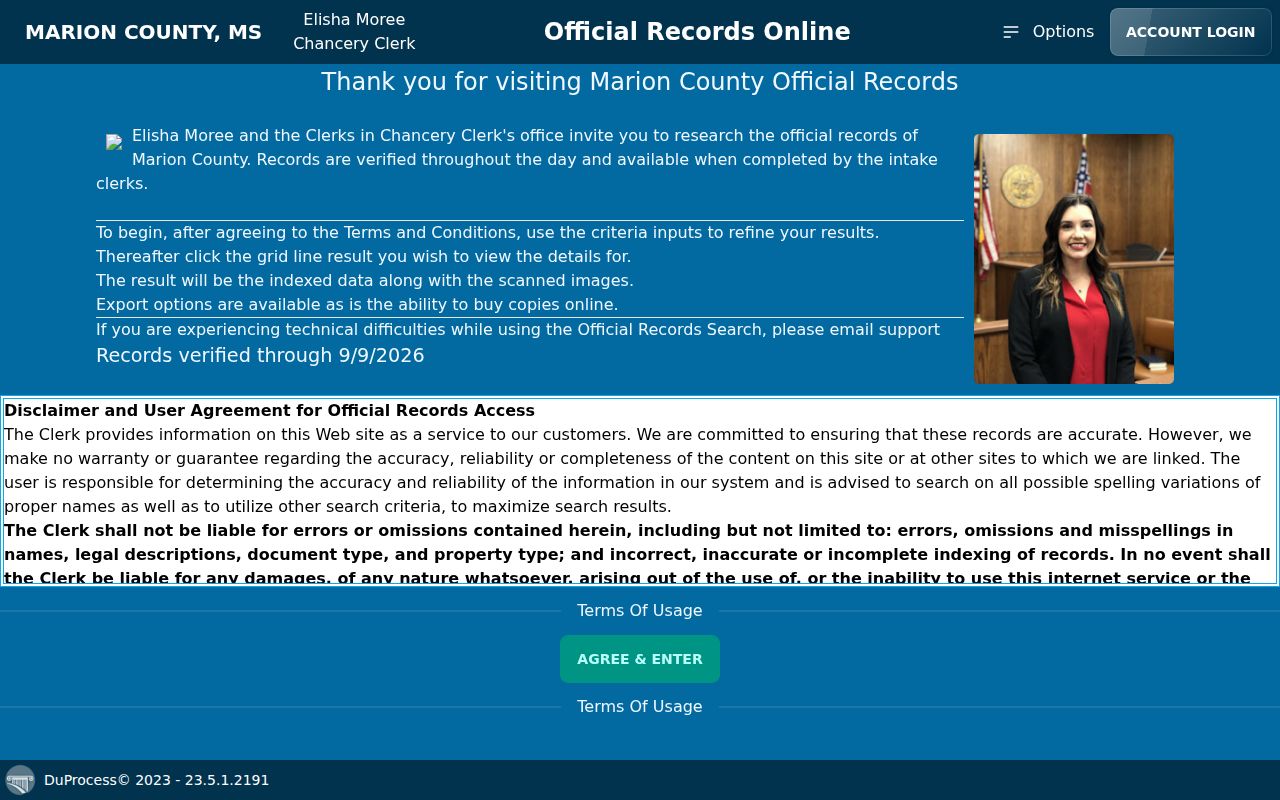
The form can narrow a former-owner search by party role, date, instrument, parcel, legal description, and location fields. Grab every reference first. Copy it all before opening the next earlier transfer. A book and page can bridge into an older volume even when the prior transaction sits beyond the online range.
Reverse Marion County's Deed Chain
The cleanest chain begins with a confirmed parcel. Add its most recent deed. Match parcel or PPIN, deed book and page, legal description, subdivision, and transfer date instead of trusting a surname search. Then turn the grantor on that deed into the grantee for the next search backward.
- Find the present parcel in GIS or the assessor system. Save its PPIN, parcel number, deed reference and legal description.
- Open the newest matching deed. Record its grantee, grantor, deed type, filing date, book/page and land description.
- Search the named grantor as an earlier grantee. Narrow the results with the same parcel, subdivision or description.
- Repeat one conveyance at a time. At 1997, carry the last book/page to the courthouse and continue in the physical index.
- Grantor
- The person or entity conveying an interest.
- Grantee
- The person or entity receiving that interest.
- Chain of title
- The ordered links of instruments affecting the same land.
- Reverse index
- An index used to find instruments by the receiving party.
- Warranty and quitclaim deeds
- A warranty deed carries title promises; a quitclaim transfers only whatever interest the grantor has.
Anchor Marion County Past Owners
A past owner's name is never enough by itself. Marion County's TaxParcel layer exposes PPIN, parcel number, deed book, deed page, deed date, legal description, subdivision code, sale date, and an alternate parcel number. They can separate two owners who share a name. Identifiers can still change. A split, combination, or correction may rewrite a parcel number, so keep the written legal description close.
Spelling diverges between offices too. The recorder writes "Columbian Heights." The map data says "Columbia Heights." Search both forms. For a lot-and-block parcel, open the Subdivision layer for SubName, Book, and Page clues, then match them to the deed index. Older acreage may go by section, township, and range.
Note: Street and mailing addresses can change, but a matched legal description with book and page makes a far stronger historical link.
Marion County Estates Break Chains
Not every ownership change was an ordinary sale. A death could move property through a will, an administration, an heirship, an executor's deed, a commissioner's deed, or a court order. Estate names linger. An estate can sit on the tax roll while the legal transfer is still being resolved. When the deed sequence stops, search Chancery Court estate material under the deceased owner's name. Note every parcel description in the file.
Film fills the gaps. The FamilySearch Marion County catalog identifies Chancery Clerk will books and records on film. The Mississippi Department of Archives and History also helps. Its inventories and microfilm catalogs cover county records. A will shows intent, though, and does not prove that every later step in title was recorded. Rejoin the land chain at the next deed or court-approved conveyance.
Marion County Partial Conveyances
A ownership chain can split in several directions. One grantor might convey only part of an acreage tract. The grantor might hold back a mineral interest. The deed could also fix a flawed legal description or re-record an earlier one. The recorder's document menu spans deeds, deeds of trust, releases, assignments, liens, lis pendens, plats and related instruments. Fewer than half actually move title. The rest still explain why names or legal descriptions changed over time.
Put acreage figures, quarter-quarter calls, subdivision lot and block, and the full legal description side by side before drawing conclusions. A correction or re-record should attach to the original instrument. It should not read as a new owner of record. A deed of trust likewise secures a debt and is never a sale. Give tax, sheriff, executor and commissioner deeds extra care. A court, estate, or collection process often supplies context the deed itself omits. When a deed references a case, search the related court or probate file.
Older Marion County Owner Evidence
For older Marion County owner evidence, the courthouse is still the main channel. Call or visit the Marion County Chancery Clerk at 250 Broad Street in Columbia with the last known book/page, any name variants, and the legal description. A courthouse terminal can surface an index entry or image the web route misses. The county fee page governs copies. The task here is keeping the chain reference intact; the deed-records page carries the full copy-order process.
MDAH offers a deeper fallback. Its local-government records office, pre-1920 county inventory, county-record microfilm catalog and Marion County finding aids extend the search. Holdings include a selected 1837 Marion County tax record and original county series, though not a complete year-by-year land-book run online. Newspaper holdings begin with an item dated 1903. Local directories may name occupants. These sources add context. They do not establish title alone.
Limits of Marion County Owner History
How far a parcel's former owners can be traced depends on which record series survived. It also depends on how well they are indexed. The public web trail is firm only from 1997 forward. Earlier books, plats, wills, tax material and archive series take a direct search. No single earliest surviving Marion County deed book has been established. No complete digitized run exists either, so no precise beginning date should be assumed.
Keep occupancy and ownership apart too. A directory listing can show someone was tied to a place. So can a newspaper item or a mailing address. A tax roll shows the owner listed for one assessment year. The recorded conveyance and its legal description give the stronger ownership link. Even a chain that looks complete is research evidence, not a professional title opinion.
Lawful use. Marion County former-owner records support house history, heir research and property diligence. Never use them to track, intimidate or harass a living person.