
Decode Marion County Property Value
Every Marion County property value needs a label before it means anything. Mississippi starts with true value. A class ratio is then applied to reach assessed value for tax purposes. A deed's consideration field records what a sale actually brought. Market value, by contrast, is an opinion tied to a date. The assessor's TaxParcel layer can also split the appraisal. It breaks out land, improvement, cultivated and uncultivated parts.
| Value type | Meaning | Official record |
|---|---|---|
| True value | The statutory full-value starting point | Assessor appraisal framework |
| Assessed value | True value multiplied by the property-class ratio | Assessor roll and parcel attributes |
| Sale consideration | A figure tied to a recorded transfer, if stated | Deed image and recorder search |
| Market opinion | An estimate of likely sale value on a specific date | Licensed appraisal, not the tax parcel |
Mississippi class ratios drive the math. Class I owner-occupied single-family residential property uses 10 percent, while Class II other real property uses 15 percent. Assessed value therefore lands well below true value by design. Never set it beside a sale price without first weighing the class, the date, and the purpose behind each figure. Class I owner-occupied single-family residential property uses 10 percent. Class II other real property uses 15 percent instead. Never set it beside a sale price without first weighing the class. Also weigh the date, the purpose, and how each figure was built.
Marion County Assessment Ratios
The Mississippi Department of Revenue appraisal guidance spells out the class rules county assessors apply. Multiply true value by the class ratio and you get assessed value. Millage enters later, when the tax bill is computed. A value comparison should stop before it turns into tax-bill analysis.
Class matters most. A Class I parcel and a Class II parcel cannot be compared at the assessed-value level. The two use different ratios. Homestead status and exemption codes can shift taxable treatment. They do this without touching the land or structure itself. The county's homestead forms document the application route. The appraisal record supplies the value-year context.
View Marion County Value Fields
The Marion County TaxParcel service makes the underlying attribute names public.
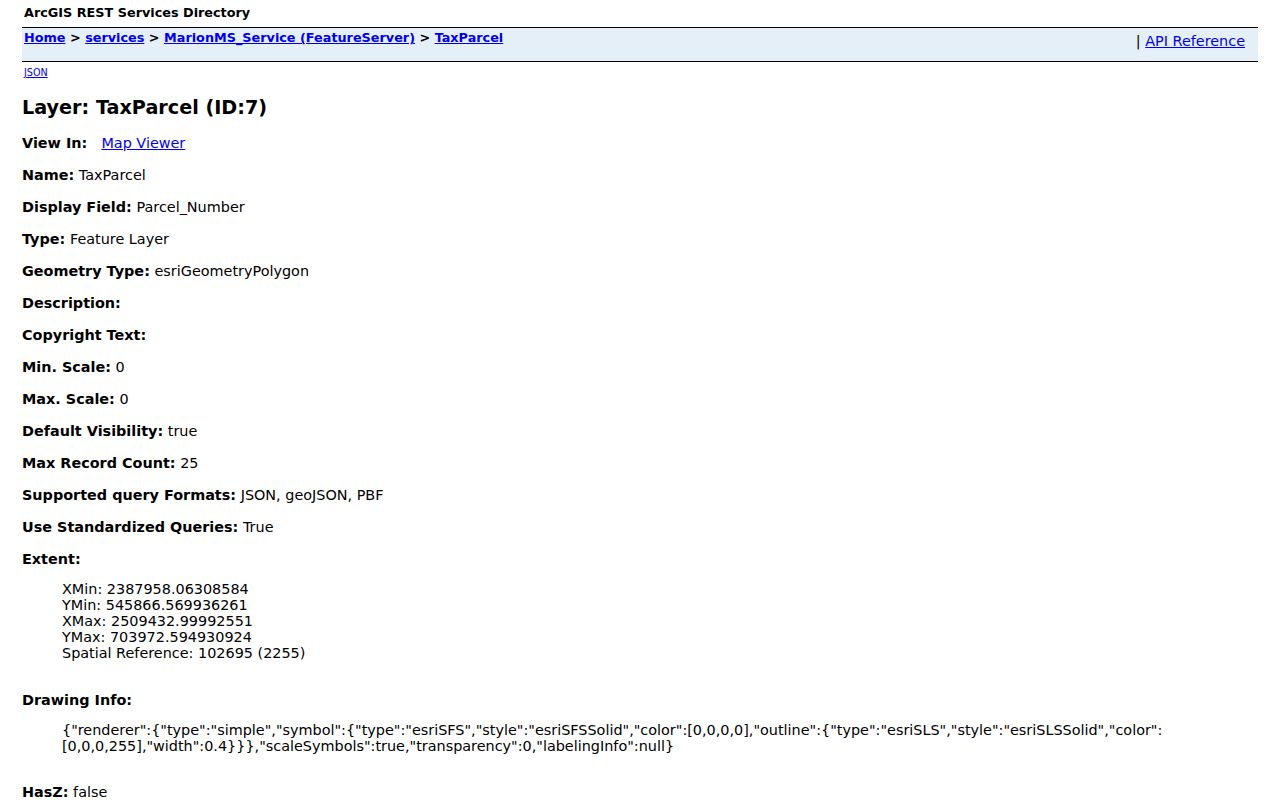
The schema carries cultivated, uncultivated and improvement value fields, plus TOTAL_ASSESED_VAL, exemption code, sale date, sale price, tax district and year. Yes, the published field name is misspelled. It still does its job. Not every field gets filled, so blanks and zeroes call for a deed or assessor check before you trust them.
Find Marion County Assessed Value
Deltacomputer's county-linked tools let you search by name, street address, parcel number, or PPIN. The PPIN is often the cleanest key. It carries cleanly into GIS and into the recorder's records. It keeps one thread through every lookup. Whatever value you pull, note the displayed tax year beside it.
- Search the Marion County appraisal form by address. If needed, switch to owner, parcel number or PPIN.
- Confirm that the result matches the legal description, situs and deed reference. Save the value year and exemption code.
- Read the land, improvement and total assessed fields that are actually populated. Do not infer a missing component.
- Check the latest recorded deed for its date and consideration evidence. Treat that figure as a past transaction, not today's market estimate.
- Assessed value
- The value after the statutory class ratio is applied.
- True value
- The assessor's full-value basis before the class ratio.
- Assessment ratio
- The percentage used to convert true value into assessed value.
- Sale consideration
- The amount stated or indexed for a transfer, which may need the deed image for context.
- Revaluation
- A systematic update of real-property values.
A Marion County Zero Sale
One Marion County parcel shows why a raw number needs context. The GIS entry for PPIN 16965 lists parcel 002-06-000-06-001.01, a deed dated March 11, 2024, and deed book 2024 page 817. Its total assessed value is 69. Its sale price is 0. That zero is just a field value, not proof the property changed hands without consideration or market worth. Take the book and page into the Chancery Clerk's deed image and read the actual instrument. Family transfers, estates, trusts, corrections, and other deed types can all produce figures that behave nothing like an open-market sale. The legal description also tells you whether the deed and the parcel record cover the same 2.7-acre tract.
Marion County Revaluation Timing
Mississippi revalues real property at least once every four years. About one quarter of parcels get a close look each year. That cycle explains why a tax-roll figure can trail a fast-moving market. Ownership is also keyed to January 1. A deed recorded later in the year may be newer than the owner name on the current roll.
Columbia and other Marion County places publish no city-only or neighborhood trend series. A sound trend study compares the same parcel fields across tax years. It then weighs deed sale dates and prices. Skip any claimed county median that no official source documents.
Note: Online Deltacomputer data is updated often but may lag courthouse activity. Save both the source and your retrieval date.
Marion County Sale Evidence
The recorder search offers consideration-value minimum and maximum fields. It also adds instrument type, parties, date, parcel, PPIN, subdivision, and legal-description terms. That makes the deed index the right tool for investigating a recorded transaction. The index summary alone may lack what you need to interpret the price. Open the deed image itself. Ask whether the transfer covered the full parcel. Or ask if it covered a partial interest, or several parcels at once. Look for a correction or a re-record. Then compare the sale date with the value year. A prior sale is one market clue. But age, transfer conditions, and physical changes can make it a rough guide to current property value.
Exemptions Alter Marion County Treatment
Every assessor record carries an exemption code. Marion County publishes its own homestead instructions, plus a worksheet for owners. Homestead treatment can shift a parcel's class and its taxable result. What it cannot do is convert assessed value into market value. Nor does it promise that the parcel would sell at any particular amount.
Two similar parcels sometimes show very different tax bills. Don't blame the valuation right away. Compare class, exemption code, value year, acreage, and improvement fields side by side first. Payment status, detailed bills, and appeal routes live with Marion County property tax records. Exemption data matters here for one reason. It explains why taxable treatment can diverge from the value concept you set out to compare.
Limits of Marion County Value Data
An assessed value is a tax figure born inside a mass-appraisal system. It is not a market opinion. A buyer, seller, or licensed appraiser may weigh conditions the formula never sees. GIS lines deserve the same caution, since they are tax-map references rather than survey results. A value may rest on mapped acreage. But the deed or a survey may describe different ground. Check it.
Online property records can also run stale or incomplete. Match the parcel, the year, and the source. Inspect the deed behind any sale figure. Get a licensed appraisal whenever a current market opinion truly matters. That order keeps Marion County public value data in its proper role.
Value is not price. A Marion County assessed value supports taxation. It is not a promise of sale price and is not a licensed appraisal.