
Fields in Marion Tax Records
Marion County property tax records split cleanly into two halves. The appraisal half names the owner carried on the annual roll, classifies the land, and publishes value and exemption data. The collection half tracks bills, payments, delinquency, and sale administration.
| Field | What It Shows | Where |
|---|---|---|
| Owner and mailing address | Name and notice address on the annual roll | Tax Assessor |
| Assessed value | Tax value after the class ratio is applied | Tax Assessor and GIS |
| Exemption code | Published homestead or other tax treatment | Tax Assessor and GIS |
| Tax bill and status | Amount billed, paid, or delinquent | Tax Collector |
| Tax district | District code tied to the parcel | Tax roll and GIS |
Assessed value is not the deed's sale consideration. It is not a private appraisal either. The tax bill simply applies governing rates and credits to the taxable record. Keep timing in mind, too: a deed can post before the owner name moves onto the next annual roll.
Assessor Versus Marion Tax Collector
The Marion County Tax Assessor/Collector office combines contact information but keeps the functions distinct. The assessor annually locates and classifies taxable property, maintains ownership maps, values real and personal property, and presents the rolls to the Board of Supervisors. The collector handles real estate, personal property, manufactured-home, and motor-vehicle collections, installment payments, and the annual tax sale.
Call the assessor at 601-731-3798 about classification, value, parcel identity, or homestead. Call the collector at 601-736-8256 about the bill, payment, delinquency, or a tax sale. Both routes center on the courthouse at 250 Broad Street in Columbia.
Note: Use the parcel number or PPIN in every tax question so staff can distinguish same-name owners and nearby tracts.
Search Marion Assessment Fields
The Deltacomputer appraisal form takes four direct keys. These are Name in last-name-first form, Address by number and street, Parcel Number, and PPIN. Its Property Link companion adds section, township, and range for rural legal descriptions. The form states no required minimum and no full historic coverage span.
The county's live GIS attributes go further. They list owner, mailing-address slots, acreage, tax district, exemption code, land-use codes, deed book, page, and date, legal description, sale date and price, total assessed value, and separate cultivated, uncultivated, and improvement value fields. Deltacomputer cautions that web data uploads often but can lag courthouse activity.
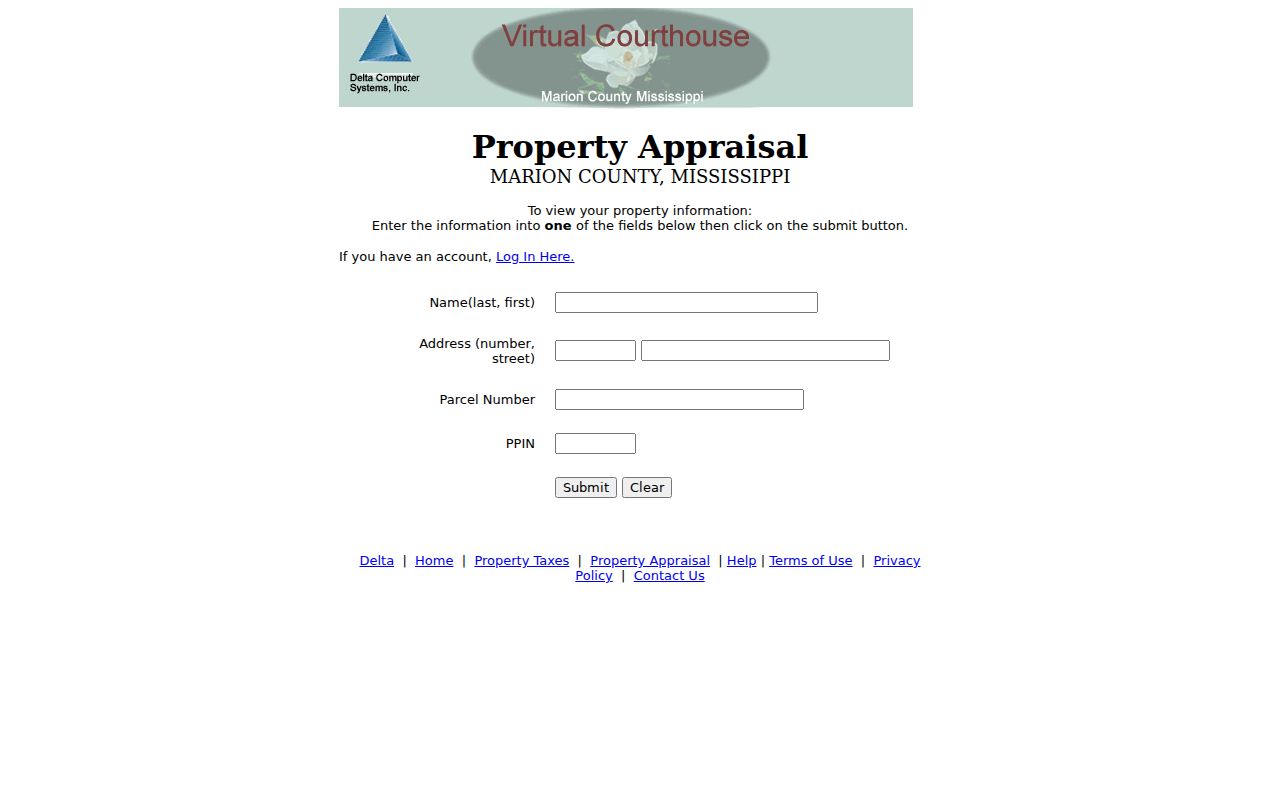
The assessor screen confirms the four direct search keys. When the tax-roll owner looks stale, check the recent deed separately.
Marion Assessment Ratios
Mississippi assesses Class I owner-occupied, single-family residential property at 10 percent of true value. Class II other real property gets 15 percent. Revaluation comes at least every four years. Roughly one-quarter is closely inspected each year under the statewide framework. That schedule keeps rolls current across Marion County.
The ratio explains the gap. Assessed value can sit far below a property's broad market meaning. It never shows what a buyer would pay. Land, improvements, use, exemptions, and the record year all shape the picture. Each one leaves its mark in Marion County property tax records.
- True value
- The state's full-value starting concept for appraisal.
- Assessment ratio
- The class percentage applied to true value.
- Assessed value
- The tax value produced after classification.
- Millage or levy
- The rate applied in computing the property tax.
- Tax lien
- A claim tied to unpaid tax under the tax-sale process.
Look Up a Marion Tax Bill
Start by pinning down the exact parcel in the assessment search. Then turn to the county-linked tax payment service, which covers real, personal, and mobile-home taxes. Read the account and the year before you enter a payment.
- Search the appraisal service by address, owner, parcel, or PPIN.
- Match the owner, legal description, tax district, and record year.
- Open the corresponding payment account and confirm the tax year and status.
- Check the assessor record for the published exemption code.
- Ask the Tax Collector directly about delinquency, sale, or redemption.
The payment portal adds a nonrefundable service fee of 3.75 percent, or $3.75 minimum. Skip it when you need a record rather than a payment, and use the office or copy-request route instead.
Marion Homestead Filing Window
Marion County's homestead instructions open a January 2 through April 1 application window. Bring recorded copies of all deeds, identification, Social Security cards, birth dates, vehicle tags, purchase or building information, and mobile-home registration when relevant. Age, disability, or disabled-veteran treatment calls for the listed proof. The worksheet itself gathers applicant and spouse details, physical and mailing addresses, marital and residency facts, purchase terms, past homestead history, and tag numbers.
Treat a homestead code as a tax classification clue. It is not stand-alone proof of title or occupancy.
Note: Homestead materials cite the Assessor's Office and sometimes Suite 4, so confirm the counter location before visiting.
Copies From Marion Tax Records
The county Tax Collector copy form offers an offline record channel. The stated turnaround is two business days. A completed request may be scanned to taxcollector@marioncountyms.gov. That route fits when the payment interface cannot answer a historical or document-copy question.
In-person, phone, email, and written requests all remain open through the Assessor/Collector. A focused request should name the parcel, PPIN, owner, tax year, and desired record. It should also say whether inspection or a copy is wanted. The Mississippi Public Records Act supplies a written-request fallback as well. It applies subject to statutory exceptions and actual-cost fees.
Faster copy request. Include both the PPIN and full parcel number; the county form states a two-business-day process and permits email delivery.
Marion Delinquency and Tax Sale
The county publishes no standalone delinquency search. Go to the Tax Collector instead. Ask for the current amount, tax year, sale date, purchaser, and redemption status. The collector runs the annual sale. The Chancery Clerk traces owners and lienors, sends pre-foreclosure notices and redemption rights, and issues tax deeds once a sale matures.
Marion County property records show the paper trail in the land index. Its instrument types include Notice Of Tax Sale, Tax Sale, Tax Deed, and Land Redemption Rec. The rest are Release Tax Sales, Clerk's Deed, and Sheriff's Deed. Read the collector's account next to the recorded instruments. A notice is not a deed. A tax deed will not answer every question about redemption or a later release.
Work the sequence in order. Start with the bill and year. Verify the parcel description. Ask whether the tax was sold. Then inspect every notice, redemption entry, release, or deed recorded against the land. Court records matter when title, notice, foreclosure, or redemption was disputed. Never infer the owner of record from a delinquent list or a tax-sale notice alone.
Contest a Marion Assessment
Start with the Tax Assessor. Ask which value, class, land detail, or improvement fact produced the disputed figure. Bring the parcel ID and record year. Bring photos, deed or survey details, and comparable facts that speak to the county's record. The Mississippi Department of Revenue explains the Board process and current property-tax rules.
No single verified Marion filing date covers every cycle. Confirm the current calendar with the assessor rather than trusting a general state timetable. Wait until a bill is due. You may miss the review stage tied to the assessment roll.
Appeal window. Confirm the current Marion County roll-review and Board deadline with the Tax Assessor; the research does not verify one fixed date for every cycle.
For help reading assessed value apart from the bill, use the Marion County property value resource. Tax payment, exemption, delinquency, and appeal issues stay with the Assessor/Collector and the Board process.